From Crew Culture to Sweetness and Light
The discovery of gold in 1850 in Victoria sparked a series of extraordinarily rapid social and economic transformations in the colony, newly independent of New South Wales from 1851. Within three years, Victoria’s settler population grew more than threefold, from around seventy-five thousand in 1851 to two hundred and forty thousand in 1854, then doubled again to over half a million by 1861. This massive influx of immigrants came not only from Britain and its imperial possessions, as had previously been the case for almost all settlers to the Australian colonies, but also from a wider range of diverse locations. Diggers came from continental Europe – Germany, Italy, France, Scandinavia and Eastern Europe. They also included Americans, travelling across the Pacific from the gold rushes of California; Chinese people from Guangdong, Fujian and other south-eastern provinces; and other hopeful fortune-seekers drawn from all corners of the globe by the promise of gold and its associated economic boom.
Gold fever created instant canvas cities, polyglot and cosmopolitan, culturally heterogeneous and politically turbulent. Predominantly young, male, and detached from family relationships, gold seekers were widely seen as an undisciplined and troublingly itinerant population. The sudden riches on offer presented an exaggerated version of capitalist development while eroding established hierarchies of wealth and power. To contemporary observers, goldrush society seemed a delirious and threatening runaway modernity. ‘Its disruptions’, commented Anthony Trollope, ‘are those of an earthquake’ (244). Melbourne’s Anglican Bishop, Charles Perry, deplored ‘the great variety of nations and races, and the almost total want of social intercourse of the people with one another’ (qtd. in Goodman 19). Perry’s wife Frances, meanwhile, wrote of gold as ‘that hateful, fearful, baneful subject. All wise and good men look with great alarm on this new feature in our history’ (qtd. in Goodman 155). It is in this context that we turn to an unlikely civic amenity of the Victorian goldfields – poetry – to examine its recruitment as a tool for shaping the goldfields’ chaotic environment and stabilising their transient populations. Our focus is on the community officially gazetted as Sandhurst from 1853 to 1891, at which point the name of Bendigo, long popularly preferred, was formally adopted.
Within months of prospectors finding alluvial gold there in 1851, twenty thousand diggers had arrived. Two decades later, some twelve hundred mining companies were working the quartz reefs of Sandhurst – at the time the highest-yielding goldfield in the world. Writing about these companies in 1871, Trollope singled out around twenty company names for comment. Many involved variations on the word ‘hustler’, originally a slang term for a pickpocket. But Trollope also called attention to a more genteel group of company names characterised by poetic allusions. There were, for example, ‘the Sons of Freedom’, a reference to Henry Bishop’s popular ballad of 1816, along with ‘the Sir Walter Scott’ and ‘the Lord Byron’ (273–74). In amongst the dirty, dangerous excavations and seemingly endless hustling, the mining capitalist’s occasional invocation of poetry sought to romanticise the frantic hacking and crushing of Bendigo quartz and to imagine how the hell-for-leather quest for gold might ultimately yield some more respectable, pro-social, and more-than-monetary end.
Similar desires were on display in educational spheres. In the same year that Trollope noted Scott’s name on the Sandhurst company register, the Bendigo Caledonian Society used the voluminous proceeds from its theatrical staging of Rob Roy to fund an annual Waverley Prize for the best high-school essay on Walter Scott. Celebrity authors like Scott provided conduits through which colonial populations could sluice their ethnic nostalgia, but they also became channels for activities signalling colonial permanence. The Waverley prize persists in only slightly modified form to this day.
As that prize’s name suggests, Walter Scott was certainly better known to the people of Sandhurst for his novels (Waverley foremost among them) than his poems. And the Bendigo Caledonian Society’s staging of a dramatised Rob Roy indicates the importance of further literary modes and mediations in goldfields culture, as well as their many intersecting relations, from novels on stage to the poems that so often appeared within novels. In this essay, our focus is largely restricted to the ways poetry was put to use in this nineteenth-century colonial city-in-the-making. Although reading, writing, publishing, owning, talking about or simply alluding to poetry may have been only one relatively narrow set of ways in which people engaged with literary culture in Sandhurst, it warrants being singled out. Poetry’s particular associations in this period afforded it powerful and distinctive functions in redirecting colonists’ experiences of accelerated dislocation from the past, from homelands and from social order towards ideas of permanence and respectability.
Some of these associations were influentially codified at the time by poet and literary theorist Matthew Arnold, whose Selected Poems (1878), God and the Bible (1875) and Literature and Dogma (1873) were all housed in the Sandhurst Mechanics’ Institute (henceforward SMI), an institution central to the story we tell here. In his introduction to T. H. Ward’s The English Poets (1880) – a volume also held by the SMI – Arnold wrote that ‘the future of poetry is immense, because in poetry, where it is worthy of its high destinies, our race, as time goes on, will find an ever surer and surer stay’ (xvii). For Arnold, poetry would provide enduring values even as the social purchase of religion and received traditions grew increasingly uncertain. Poetry could do this because it was the preeminent vehicle for ‘ideas’, and ideas, for Arnold, were the currency of social progress. And while social progress clearly mattered to Arnold’s middle-class readers in Victorian-era Britain, it arguably mattered even more in a rapidly growing colonial settlement like Sandhurst. Across both locations, Arnold’s calls for an apprehension of poetry’s ‘higher uses’ and ‘higher destinies’ spoke to a widespread conviction that poetry facilitated civic self-development.
It was a view owing much to Percy Bysshe Shelley’s famous pronouncement of 1821 that poets were ‘the unacknowledged legislators of the world’. But if the citizens of Sandhurst signed on quite enthusiastically to this broad Shelleyan-Arnoldian cultural program, their enthusiasm did not extend to Shelley’s poetry itself. In 1884, the SMI Library held three books about Shelley but only one by him. Along with such poets as Thomas Moore and Robert Burns, who were put to work as the ensigns of Irish and Scottish immigrant populations, a figure like Shelley, particularly as renovated by his Victorian-era biographers, provided the colonists of Sandhurst with a vehicle for performing and promulgating a complex set of values, in which good order, liberalism, humanism and sensibility could be figured as simultaneously respectable and progressive. Shelley’s actual poetry, in contrast with this idea of poetry as a signifier of a particular disposition towards social change and social order, appeared less serviceable for civic ends.
What the idea of poetry offered was importantly different from, although obviously continuous with, the affordances of literary culture more generally. The catalogues of the SMI Library and the advertisements of goldfields book merchants make clear that novels were far and away the most popular recreational reading material in Sandhurst. Indeed, the popularity of the novel might be seen to have contributed to the special status of at least some forms of poetry. In 1875 one patron of the SMI decried the Library Committee’s enthusiasm for supplying its members with ‘trashy Novels’ (Suggestions 13), purchased, this member complained, at the expense of the University Calendar, a novel-free document that mandated matriculants’ reading of poems by John Milton, Alfred Tennyson and Thomas Gray (University of Melbourne Calendar 109). Two years later, another member suggested ‘that a copy of D. G. Rossetti’s poems be procured. It is a work which no literary institute should be without and has provoked the profoundest interest in all admirers of lyric poetry’ (Suggestions 47). With their avowed preference for poetry, these members laid claim to a higher erudition. One member spurned novels for poetry in a quest for admission to the colony’s only university; the other invoked lyric poetry in reimagining the Mechanics’ Institute as a more elevated ‘literary institute’. Reaching via poetry for these kinds of rarefied social and cultural status was perhaps a wishful response to the realities of life on the goldfields.
In Sandhurst, poetry was routinely presented across multi-faceted forms, registers and venues as a way to ameliorate or civilise communities; it was harnessed to what McCalman et al. call ‘the powerful impulse towards respectability’ and the ‘unusually zealous policing of the boundaries of propriety’ that were provoked by ‘the reputation of the diggings’ (17). Original poems were published in great numbers in the Bendigo Advertiser, a newspaper founded within two years of the first news of gold in Bendigo Creek. Poetry was shelved in the library of the SMI, established a year later in 1854. And it was commonly recited at public gatherings and variety performances. As we will show, these three institutions – the newspaper, the mechanics’ institute, and the public performance – were all mobilised in programs of civic improvement; they provided important mechanisms for ordering and stabilising the itinerant populations of Sandhurst. Poetry was far from incidental, we argue, to the positioning of these institutions as means to regulate the turbulent and cosmopolitan modernity of the goldfields.
To demonstrate how these institutions put poetry to work to signal cultural legitimacy and impose moral order, we look at the SMI, the Bendigo Advertiser and popular public performances in closer detail. In each case, we excavate a selection of representative poems buried in the archival tailings. As our selections will suggest, the forms, registers and subject matters of the poetry held and presented through these three institutions differed significantly. One key difference concerned locality. The poetry housed in the shelves of the SMI was overwhelmingly written abroad by canonical British, Irish and North American poets. In this context, a locally produced volume acquired by the SMI in the 1860s stands out as an important exception to this general rule. The newspapers, by contrast, largely published the works of local contributors, with occasional reprints of recent offerings by established poets abroad. There were also important differences of class.
The SMI charged an annual membership fee of £1 in 1870, and mandated middle-class decorum amongst its readers. Matters of social etiquette appear frequently in the Suggestions Book for Members, with demands for the provision of a spittoon, for example, and complaints about ‘juveniles’ whistling in the chess room. A copy of the Bendigo Advertiser in 1870, meanwhile, cost only threepence, making it available to a wider section of society. Yet there would certainly have been overlap between the patrons of these two Bendigonian institutions. Indeed, the proprietors of the Advertiser and other local and provincial newspapers provided copies for the SMI reading room (Report of the Committee 5). Considering the work of newspaper editors on the one hand, and librarians at the Institute on the other, reveals the sometimes shared, sometimes diverging social aims and projects of those who put poetry on the curriculum of civic improvement.
Historian James Belich has described the diggings as the last great manifestation of what he has dubbed ‘crew culture’ – the matrix of rough-and-ready social conventions that shaped the life of the disposable, mobile, male workforce of imperial expansion (323–24). Resistance to mining licence fees enforced by government troops resulted in disturbances such as the ‘Red Ribbon’ protests in Sandhurst and, in Ballarat – that other great Victorian goldfields boomtown – in Australia’s most celebrated moment of civil revolt, the Eureka rebellion. While these uprisings were violently suppressed, military force was seen as a last resort in Victoria – at least, that is, when employed against white settler colonists, however unruly they might be. More effective ways to secure social order and subordination appeared to be on offer in the repertoire of governmentality that the colonies had adopted from Britain. Education, in particular, was seen to exercise an indispensable influence of social moderation.
In August 1854, the Sandhurst correspondent of the Melbourne Argus, deploring ‘the desultory and nomadic habits of gold-diggers’, suggested that
the character of a large portion of the succeeding generation, brought up amidst all the demoralising influences of such an unsettled and vagabond life as that of the gold-digger, and almost destitute either of religious or secular instruction, may be anticipated. One of the most serious and important duties of the Government is the education of the thousands of children on the gold-fields, and how well this important duty is at present attended to, let the condition of Bendigo testify. (‘Bendigo’ 5)
Goldfields children would shortly be taken in hand by the Victorian National Schools Board. But what of their equally untutored parents? How might they be transformed into the type of law-abiding, sober-living, civic-minded citizenry of which the new colony seemed in such dire need? And if adult education was to act as a moderating, disciplining force, how exactly was that to work?
On the Shelves of the Sandhurst Mechanics’ Institute
By 1854, Sandhurst possessed many amenities that might make life on the colonial frontier more comfortable and familiar to newly arrived settlers: theatres, pubs, shops of all types, a hospital and newspapers. What the young town did not have, however, was a space devoted to sobriety, sociability and intellectual improvement – a cultural counterweight to the social dislocations and political unrest of shantytown goldfields life. On 3 April 1854, a group of Sandhurst locals gathered at the Bendigo Hotel to hear a report prepared by a provisional committee to consider the establishment of a local Mechanics Institute. A grant of land on McCrae Street was soon secured from the government, and the SMI began in 1854 as a ‘flimsy makeshift structure some sixty feet long and thirty feet wide, with canvas walls stretched over a fifteen-foot-high timber frame’ (Cusack 10). This temporary pavilion was originally designed to house the entries in a local Industrial Exhibition, with the winning entries sent on to the great Paris Exhibition of 1856. It was not until mid-1856 that a permanent building for the SMI was completed. By 1859, Sandhurst could boast three permanent venues for learning, with the Sandhurst Athenaeum and the Temperance Hall vying with the SMI for audience share.
The social composition of the group that established the SMI provides some indication of the agendas that inspired it. It included pharmacists, Justices of the Peace, solicitors, bankers, brewers and local parliamentary representatives. The first President of the Institute was J. H. O’Loughlin, one of the first barristers to reside in Sandhurst. These were largely professional men, not diggers. They were heavily involved in promoting the civic amenity of their community. Many played important roles, for example, in the design, financing and management of Sandhurst’s reticulated water system. They were often partners, financiers or providers of professional services to the companies that, after the initial rush, were coming to dominate mining around Sandhurst with the shift from alluvial to industrial quartz mining. And they were typically politically active, drawing on parliamentary connections to secure a grant of £7,500 to the fledgling SMI from the Victorian Legislative Council.
Supported by government in Melbourne, the SMI was oriented to the forming of a new sense of civic pride and community belonging; for its founders, it was a key element in Sandhurst’s elevation to respectability. As Sarah Comyn has written, goldfields mechanics’ institutes, in fostering ‘literary sociability’, hoped to lend ‘respectability to the economic substrate of the town: gold’ (448). For colonial authorities seeking to temper and discipline the motley society that had been brought so suddenly into being, mechanics’ institutes offered an appealing strategy.
In this regard, Sandhurst was typical of the larger movement of mechanics’ institutes in colonial Victoria. The first mechanics’ institutes had been established in Edinburgh, Glasgow and London in the 1820s to expand education to the working classes and soon spread throughout Britain. Martyn Walker notes that with the industrialisation of manufacturing, ‘there was a need, albeit small to start with, for adults having some understanding of rudimentary science, mathematics, English grammar and reading’ (5). But whereas in Britain institutes often involved significant levels of working-class participation and self-organisation, colonial institutes like the SMI tended to be created and mobilised by local dignitaries and professionals. Although they retained the word ‘mechanics’ from the British model, this became something of a misnomer in colonial practice, no longer referring in any direct sense to manual or waged labourers or other ‘rude mechanicals’. To the contrary, colonial mechanics’ institutes were government-funded and solidly middle-class projects of social reform, improvement and education.
It is in this light, we contend, that the activities and practices undertaken by the SMI to promote literary culture are best understood. The instrumental positioning of literature as a medium for middle-class projects of civic self-fashioning sat uncomfortably with the higher claims and values that were still widely associated with literary writing and, in particular, with poetry. What became of the cultural institution of Literature with a capital L – exemplified by the poetry of Romanticism and its afterlives: the Shelleyan-Arnoldian program sketched above – when operationalised within the institutional ensemble of the SMI?
The SMI’s library housed a wide range of reading materials from technical manuals to newspapers, journals and popular novels. In terms of literary works, the tastes of the patrons of the SMI tended to reflect those of the period more generally. Throughout the anglophone world, this was a time of declining sales for volumes of poetry and an unparalleled appetite for prose fiction. William St. Clair notes that during the 1830s ‘poetry seemed suddenly to have lost its long primacy as the most highly regarded literary genre and the form most favoured by readers’ (414). This popular interest in fiction is reflected in the list of books purchased for the Institute during 1866, in which twenty volumes of poetry were dwarfed by the more than three hundred novels added to the shelves.
Sandhurst’s thirst for fiction tallies with the findings of Julieanne Lamond’s study of borrowers from the Mechanics’ and Miner’s Institute of the small coal-mining town of Lambton, New South Wales, from 1903 to 1912. Lamond notes that although education and intellectual edification were ostensibly central to the rationale for the formation of such institutions, in Lambton readers ‘consistently foiled any attempt at formal education or moral uplift: they read indiscriminate amounts of light or mass-market fiction’ (361). In 1867, the Bendigo Advertiser similarly noted the primacy of recreational reading, remarking that novels had
contributed to the amusement and instruction of a numerous class of readers, who, after the fatigues of the day, both bodily and mental, confess their inability to pursue the study of abstruse or scientific subjects, who fully appreciate the value of the works which are to be found in this library. (‘Sandhurst Mechanics’ Institute’ 3)
Novels, in this account, provided the perfect antidote to the arduous business of goldfields life.
Peter Thompson has calculated that in 1881 there were more than twenty-seven thousand loans from the SMI of books categorised as ‘novels, tales and sketches’, against just one hundred and forty for those in the category ‘poetry and drama’ (3). But despite readers’ evident reluctance to borrow poetry, there can be little doubt that it was regarded as central nonetheless to the larger civic agenda for which mechanics’ institutes were established in Victoria. The priority awarded to poetry within the mission of the SMI can be seen not least in its public programs, in which the public recitation of poems, public lectures on poets and ‘Popular Readings’ all figured prominently. Coverage in the Bendigo Advertiser in June 1867 gives a sense of what these readings – miscellaneous in nature, but inclined strongly towards poetry and song – involved:
After the President’s address Mr. Cope sang ‘Farewell to the Mountain,’ from Barnett’s English opera of the ‘Mountain Sylph,’ and received an encore, when he sang ‘There’s a Land that Bears a Well-Known Name,’ both being well suited to the singer’s capacity and voice. In this, the first portion of the programme, there was a reading by Dr. Stilwell – a treatise by Akenside on poetry, a comic song by Mr Santly, the recitation of Byron’s ‘Isles of Greece’ by the President, a duet by Mrs Ellis and Mr Towle, and the reading of the celebrated trial scene of ‘Bardell vs Pickwick’ from Dickens’s novel, by Mr Martley – the last named performance being the gem of the evening. (‘Popular Readings’ 2)
Perhaps it is not surprising that an extract from a novel by the extraordinarily popular Dickens was regarded as the ‘gem of the evening’. Yet it is notable that poetic treatises and recitations are included prominently in the schedule of events, alongside comic songs and popular opera.
The Library’s poetry collection was dominated by late eighteenth- and nineteenth-century English poets, with a few volumes by poets from America (Henry Wadsworth Longfellow, Edgar Allan Poe), Scotland (Robert Burns, Walter Scott, William Edmoundstoune Aytoun) and Ireland (Thomas Moore), along with several volumes of poems in translation (Dante, Catullus, Homer). In 1870, the collection possessed four volumes of verse by Alfred Tennyson but only three by women: Songs o’ the Drop o’Wather by ‘Harry Wandsworth Shortfellow’ (Mary Cowden Clarke); the collected works of English Chartist poet, Eliza Cook; and Poems by ‘Eliza Browning’ (that is, Elizabeth Barrett Browning). By 1884, there would be eight more volumes by Tennyson, yet only another four by female poets. Female poets, by contrast, were staples of public readings. In nearby Kyneton, for example, the Presbyterian minister gave a ‘very well attended’ lecture in 1875 on the poetry of Felicia Hemans, with recitations that met with ‘considerable applause’ (Kyneton Observer). The SMI’s relatively limited acquisition of volumes of verse by women, then, does not tell the full story of women’s role in goldfields literary culture and associated projects of community building.
Clare Wright has traced ‘the myth of the Australian goldfields as an exclusively masculine domain’ back to William Withers’s History of Ballarat (1870). But even before Withers had dubbed the Victorian miners ‘young and wifeless’ and the diggings as ‘womanless fields’ (qtd, in Wright xi, her emphasis), the diggers were being construed in print in opposition to a supposedly leisure-seeking femininity. The author of an 1853 manual, The Gold Colonies of Australia, warned women explicitly away: ‘Useless fine ladies are completely out of place in Australia’ (qtd. in Cramer 220). As Lorinda Cramer points out, though, there were not only women, but socially privileged women, on the goldfields, and women’s significant contribution to the fundraising, educational and moralising aspects of goldfields mechanics’ institutes has been well documented (Hazelwood). In 1873, a ‘ladies’ reading room’ was proposed for the SMI (‘Sandhurst Mechanics’ Institute’ (1873) 2), an affordance that acknowledged the scale of women’s participation in the literary activities of the SMI while also effectively banishing them from the reading room proper. Although relegated to lesser reading rooms, women were insistently present in goldfields literary culture, and not solely as readers. In 1884, for example, an eight-line poem appeared in the Ballarat Star titled ‘The Eureka Stockade (by a Lady who was there)’. Although women wrote about Eureka in other media, this woman’s turn to poetry connected her (and implicitly, the larger female presence at Eureka) with poetry’s symbolic authority and capacity to assert shared values.
Like that of the ‘Lady Who Was There’, most extant goldfields poetry was published only in the newspapers. But among the poetry volumes in the SMI were a small number by colonial authors, and one in particular, Prometheus the Fire-Bringer (1864), provides a window onto some of the challenges faced by writers attempting to wield literary culture on the goldfields as a means of social improvement. Prometheus was written by immigrant to the goldfields (and sometime friend of Elizabeth Barrett Browning), Richard Henry (later Hengist) Horne. Horne’s first book of poetry, Orion: An Epic Poem, had appeared in London in 1843, where Horne had enjoyed minor celebrity as a man of letters before arriving in boom-town Melbourne in 1852. A journalist writing in the Empire that year enthused over Horne and ship-mate William Howitt upon their arrival in Melbourne: ‘it is a gratifying circumstance, that talents of such high order and so peculiarly suited to such performances, should be employed in making this noble country better known to the people of England’ (‘Our First Literary Arrivals’). Once in Melbourne, in preference to the chancy labours of panning for gold, Horne took up a series of roles in the bureaucracy developed to oversee the mining industry. When he left Victoria after seventeen years to return to England, Horne departed, so theatre historian R. A. Fotheringham has claimed, as ‘Australia’s most celebrated resident poet’ (195). Other sources suggest that Horne was far from content with the fruits of this celebrity. Despite the claim that colonial writers could make a thousand pounds a year (Fowler 47), nothing like that income came Horne’s way in either Melbourne or the adjacent goldfields.
Copies of both a colonial edition of Orion, printed in Melbourne in 1854, and Prometheus the Fire Bringer are listed in the SMI’s 1884 catalogue, their acquisition no doubt partly inspired by Horne’s goldfields associations. Prometheus, which was written as well as published in the colony, is a closet drama in the style of Percy Shelley’s Prometheus Unbound (1820). In the dedication that prefaces the poem, Horne describes his habitation near Trentham, halfway between Sandhurst and Melbourne, where he was stationed in a goldfields administrative post. It is, he writes:
a place of savage solitude – this Blue Mountain of dark forests, rains, and hurricanes – (a region, nevertheless, which may, some day, suddenly become a wildly populous field of goldminers) – without books – without any society – impressed, at times, with a sense of the precariousness of human life, amidst horse-accidents, the fall of massive trees, or the evil chances of dark nights in localities abounding in waterholes and deep mining shafts in unexpected places, always left quite unprotected. (v)
As in the preface he wrote for his colonial edition of Orion, in which he claims to be in ‘an exile within an exile’, ‘in the far bush’ by ‘the lonely lagoons of Waranga’, Horne presents a picture here of colonial life in the sombre colours of goldfields gothic. This is a scene of brooding romantic threat, in which dangers extend out from natural disasters to the perils created by the crazy pace of colonial extractivism, the accidents of a galloping modernity and a vague, intimated sense of ever-present criminality. The diggings are represented as a place of concentrated darkness – Horne uses the word ‘dark’ twice in this short description – as if goldfields existence were largely a matter of stumbling around with the lights off.
It is not hard to understand the appeal of Prometheus, mythological bringer of fire and, metaphorically, of enlightenment in these circumstances. Nor is it hard to see how Horne’s retelling of the Prometheus myth might double as an allegory of his own colonial literary projects. On such a reading, Prometheus stands in for Horne himself, while Prometheus’s human beneficiaries represent colonial society; fire, meanwhile, figures Horne’s poetry. As Prometheus prepares to deliver fire to mortals, Hephaistos attempts to discourage him, telling him:
Man is not worth the risk
Which you incur. Ungrateful is the race,
By nature, more especially to those
Who serve them most, and sacrifice themselves. (16)
When penning these lines, Horne could not have avoided perceiving their relevance to his own situation as, in his own estimation, a neglected poetic genius benighted in colonial neglect.
Further colonial resonances are also at work in these lines on the ‘Ungrateful … race.’ Hephaistos’s speech closely echoes views Horne put in 1859 in his prose book Australian Facts and Prospects, in which he claimed that ‘the aborigines of these colonies’ are ‘by nature’ resistant to civilisation. Since ‘the landing of the Europeans’, Horne wrote, ‘no tribe has ever been altered for the better in any material way, and even some of the individual exceptions have returned after a time to their savage life’ (159). He went on to accuse Indigenous people of lacking not only the ‘capacity’ but also the ‘desire to assimilate themselves’ to the ‘virtues and refinements’ of what he called civilisation (159–60). In translating the familiar Prometheus story into his new colonial context, Horne then gave his material a newly racist twist. How to bring ‘civilisation’ to people who so evidently wanted nothing to do with what it is you were bringing?
We might also note the uncanny coincidence between the narrative presented in Horne’s poem and the larger project of the SMI in whose library it was shelved. For the SMI’s activities were themselves informed by a broadly Promethean framework of improvement and civilisation. The fate of Horne’s poem, sitting neglected, largely unborrowed and unread, on the Institute’s shelf, might then be seen to embody the same failure of the enlightenment project that was detailed in its pages. The impasse of the rejected civilising mission – whether we take the object of that mission to be Horne’s reluctant colonial readers or the Aboriginal people those readers were seeking to displace – is the central issue of Horne’s colonial reworking of the Prometheus story. In his poem, Prometheus’s gift of fire is spurned by the intended recipients, who instead deny Prometheus when Zeus comes to judge him for his crime:
CHORUS.
Fire!
Shall we receive that wonder from thy hand?
SUB-CHORUS THE FIRST.
We pray for things we do not understand!
PROMETHEUS.
I have promised it. By means of this bright gift,
Most useful arts, unnumbered, as unknown
To present mortals, will be re-attained,
And gradually made perfect. Brass and iron,
Will take the place of flint; pulse, berries, roots,
Exchanged for well-stored grain. Rude huts and caves,
Will be transformed to homes of artful brick,
Made with baked mud and straw, or hewn from rocks (23)
These lines echo innumerable colonial poems that rehearsed the material transformation of the colonies through the application of imported European arts and sciences. While William Charles Wentworth’s Australasia of 1823 is probably the best-known of these poems today, the genre can be traced further back to 1789 and Erasmus Darwin’s ‘The Visit of Hope to Sydney Cove, Near Botany Bay’, which similarly envisaged farms, orchards, villas, ‘broad streets’ (l. 11), ‘tall spires, and dome-capped towers’ (l. 19) rising ‘o’er the cultured land’ thanks to the colonisers’ introduction of ‘Peace, Art and Labour’ (l. 13). But in the seven decades intervening between Darwin’s poem and Horne’s, it had become an inescapable fact that colonial projects rarely ran as smoothly as originally planned, not least because they were so comprehensively rejected by the Indigenous peoples on whose lands they were being carried out, as well as by many of the settler colonial subjects who had been tasked with enacting them.
Horne’s poem then repeatedly positions its own writing and reception as an intractable colonial problem. On the one hand, it is committed to transplanting into the Victorian goldfields the Romantic Prometheanism so prominently elaborated in Mary Shelley’s Frankenstein: The Modern Prometheus (1818), Percy’s Shelley Prometheus Unbound, and Elizabeth Barrett Browning’s 1833 translation of Aeschylus’ Prometheus Bound. But that same project of cultural transplantation is also figured in the poem as abortively miscarried: the locals, it appears, want nothing of the high poetics on offer, for all its glorious classical lineage and avant-garde Romantic currency. So even as Horne rehearses narratives of the progressive course of colonial civilisation – narratives that had been detailed influentially in so many colonial poems by the 1860s – he also gives that narrative a remarkably downbeat ending. The miscarriage of colonial civilisation his poem foreshadows is aligned with the miscarried reception of his own poem and, more broadly, of Romanticism in the goldfields. You might then see this poem as constituting a kind of performative contradiction, in which its own existence stands almost heroically in opposition to the failure of the broader civilising mission it narrates. But you could equally see this as a case of a poem anticipating its own failure amidst generalised colonial indifference. And yet, for all that indifference, enthusiasts for the civilising potential of high literature did sometimes take up Horne as a mascot for colonial improvement. In a letter to the editor of the Bendigo Advertiser in October 1882, Baptist minister Henry Robinson quoted a tercet of ‘lines by R. H. Horne’ before launching into his case against alcohol.
Going to the Dogs in Song and Newsprint
Books on the SMI’s shelves were far from the only places that goldfields citizens might encounter poetry, and poetry itself was put to uses very distant from the socially improving agendas which in Horne’s Prometheus appeared predestined for failure. Poetry proliferated in the columns of colonial newspapers and other periodicals; it was declaimed on stages and performed in parlours; it jangled in goldfield music-halls and was printed in songsters and other songbooks; it found its way into advertising copy and the taglines of local merchants and tradesmen. Turning to these unliterary poems brings into focus a rather different colonial poetic history from that given recently by Martin Lyons, whose argument for ‘the supreme importance of poetry’ depends almost entirely on records of individual settlers reading books by largely canonical and British poets (81–93).
The SMI catalogue itself forms a bridge between some of the demotic forms to be found in the newspapers and these other settings and the more elevated poetry contained in the slim selection of volumes on the SMI’s shelves. Alongside lists of the volumes in the collection, the SMI’s periodically revised catalogues also contained a range of often highly inventive advertisements for local businesses, some in verse. In the 1869 SMI catalogue, for example, appears a poem advertising the ‘Cheapside Auction Mart, purveyors of iron bedsteads, bedding etc’ and its proprietor, one Edward Ley Boase:
The cheapest house on Bendigo,
I would you all observe,
Is Cheapside House, on Pall Mall,
Facing the Reserve.
There you can buy without a doubt,
The very best of Clothes,
For ready money and profits small
Is the motto of ‘Ley Boase.’ (Catalogue 1869 2)
This jingle has many of the hallmarks of Victorian light verse, not least the fact that it is littered with comically wrenched rhymes and forced mispronunciations. Composed with the aim of selling more manchester, the poem certainly presents an evocative picture of the streets and domestic merchandise of colonial Sandhurst. Indeed, precisely in its poetic insubstantiality, it captures the very flow of consumable wares into everyday life it also aims to promote.
Another advertisement from the 1874 library catalogue of the Bendigo Deutsche Verein und Lesehall – one of several organisations that operated in Sandhurst in parallel with the SMI, extending its civilising mission to non-anglophone immigrant populations – functions as an acrostic, the first letter of each line producing the text ‘HAYNES BROTHERS HARGREAVES STREET’, who were caterers and confectioners. The verse itself details the store’s victuals in resourceful rhyming couplets:
Handsome each article here that we keep;
And pure and as fresh, as wholesome as cheap.
Yes! Such variety our prized art supplies;
None can excel us for TEA and SCOTCH PIES;
English prime HAMS; while the SIXPENNY CAKE
Stands ‘universal – a dinner ’twill make.’ (Bendigo Deutsche Verein 6)
Although the focus of this composition is the visual effect of the acrostic, the poem also conjures up an imperially diverse cornucopia of comestibles brought together by the unifying power of British commerce. All this, of course, stands in transversal relationship to the German-speaking readers of the catalogue.
These advertising rhymes were only a small part of Sandhurst’s vast production of light and often comic original poetry. Sandhurst newspapers all included regular poetry columns in which humorous lines about local landscapes, occupations and citizens were a staple feature. Even today, comic verse likely remains the best-known poetry of the goldfields, with the songs of Charles ‘the Inimitable’ Thatcher still appreciated by diverse readerships, scholarly and otherwise (Both and Faher, Pinner). At the time, Thatcher was extraordinarily popular not only as a performer in Sandhurst and other goldfields townships, but also in print, where his songs circulated widely in colonial songsters and ‘minstrels’ that ran to many editions. These were songbooks in which Thatcher’s lyrics were collected and presented as texts – verses and choruses set on the page as stanzas – with the appropriate ‘air’ to which each was sung named in an accompanying note. Like the comic verse of goldfields newspapers, Thatcher’s songs were highly occasional, being keyed to day-to-day events in the diggings. This was a civic poetry of current affairs enmeshed in much rowdier scenes of sociability than could be found within the SMI.
On the goldfields, schemes to employ literary culture as a means of social regulation faced the problem that readers often seemed in such dire need of instruction: they still had, as it were, to learn how to learn. At the front of the SMI’s printed catalogues appeared a list of ‘Rules for the Reading Room’, which specified, amongst other points, that ‘no members shall smoke, talk aloud, or continue any other practice, to the annoyance of other Members’, and that ‘no dogs shall be allowed in the Reading Room’. The absence of smoking, conversation and dogs marked this space out as a scene of quiet and contemplative reading governed by decorous social norms. Thatcher’s songs, which he performed regularly at the Shamrock Hotel in Sandhurst and in similar venues there and in other goldfields townships, were created for a rather different crowd.
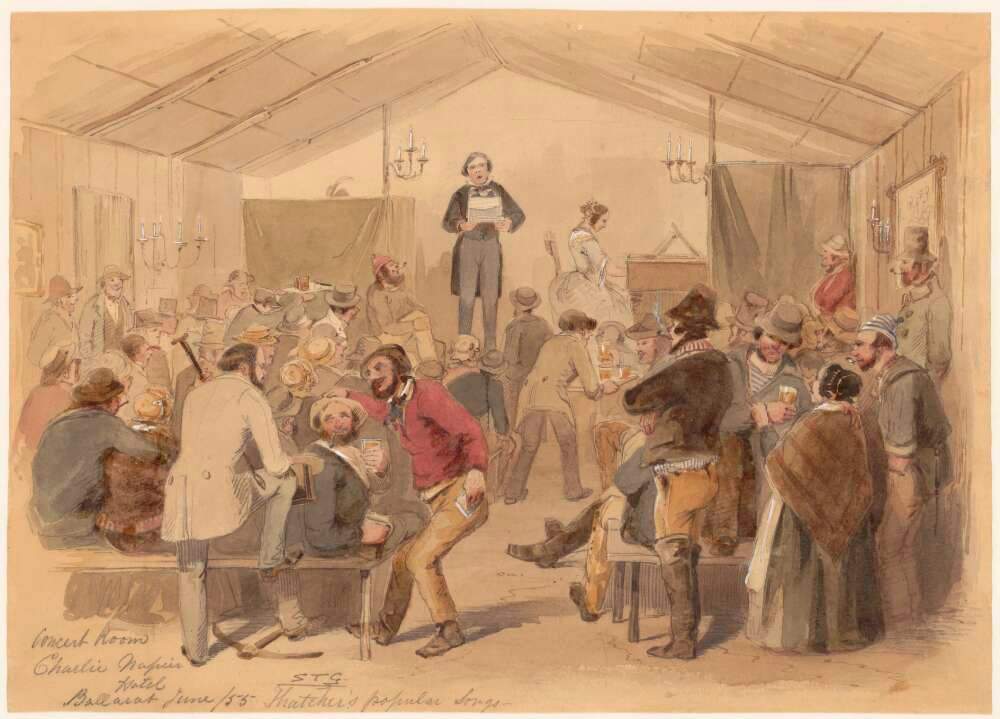
In S. T. Gill’s watercolour, ‘Concert room, Charlie Napier Hotel, Ballarat, June, ’55, Thatcher’s popular songs’, shown in Figure 1, at least six of the assembled audience can be seen smoking, and while most of the crowd appears to be attending to Thatcher’s performance, the foreground of the composition is dominated by two separate conversations – men who have turned away from the performer and face out towards the image’s viewer. There’s plenty of talking going on, and a good deal of drinking too. As represented in Gill’s image, Thatcher’s crowd was diverse – Gill depicts at least four women, one Chinese man, identifiable by his queue, and a number of middle-class and professional men, distinguishable by their top-hats and frock-coats. By far the largest group, however, are diggers, their crew-cultural affiliations clear from their Garibaldi blouses, their hats, their smoking, their drinking and their characteristic attitudes. Gill even includes a digger’s pick at the base of the image, just above his initialled signature. The same social disreputability and diversity are on display in another Gill image of goldfields performances, ‘Night Concert Ballarat, 1854’, shown in Figure 2, where they extend to include those dogs barred from the Reading Room of the SMI. One dog sits on a bench amidst the sprawling drunken diggers, its eyes fixed on an alarmed cat under the piano. Elsewhere, a digger sits, listening to the performance, his arm companionably around his dog.
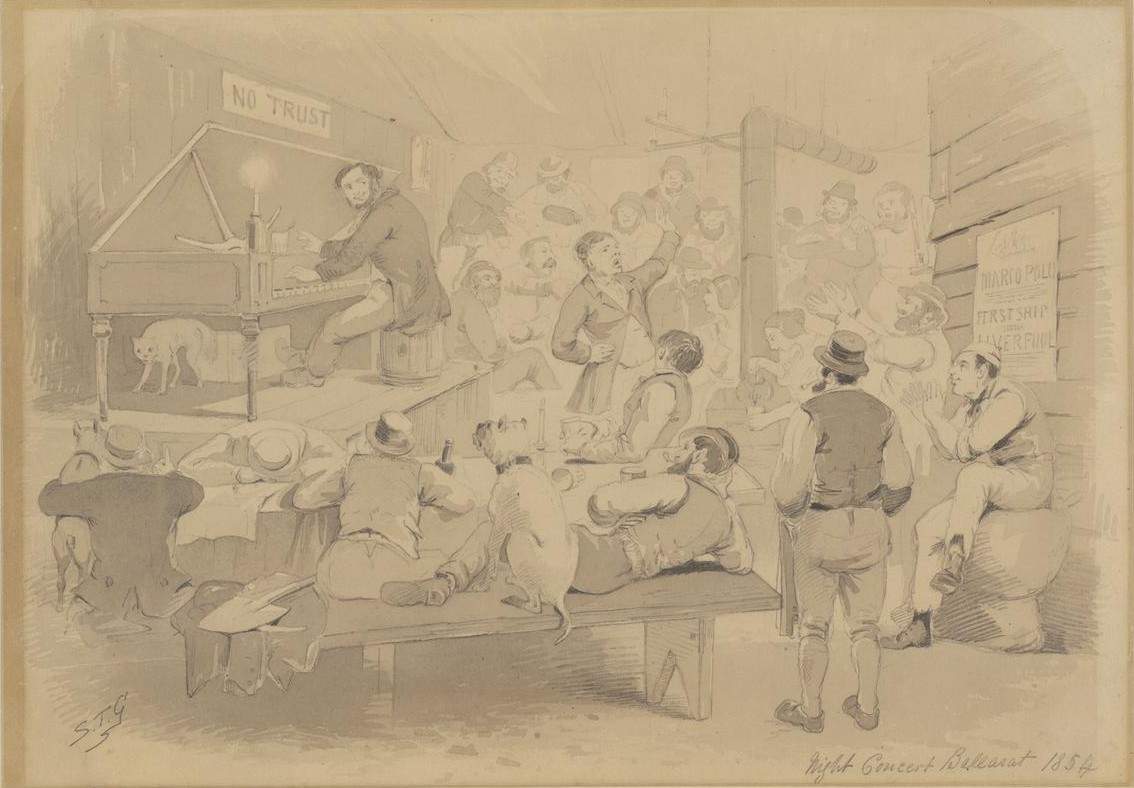
In the winter of 1856, mandatory registration of dogs was implemented in Sandhurst and Ballarat. The fee was one shilling, and unregistered dogs were to be put down and their owners fined. Thatcher took up this controversial topic in a series of songs through 1856 that included his ‘Grand meeting of the Dogs on Bendigo’. The ‘Grand Meeting’ is a political assembly of all the dogs in Sandhurst, who have convened to develop a collective response to the new regulations:
This new dog registration
Has caused an alteration
And all the canine species it has put into a fright;
And to frustrate such vile slaughter,
The dogs all in this quarter
Had a meeting on some spare ground at the Back Creek t’other night.
(Colonial Minstrel 105)
Many dogs present their views at the meeting, including a mastiff, a bulldog, a kangaroo dog and the meeting’s chairman (or should that be chairdog?) who, in ‘dog latin’, says:
…‘This registration Fills me with indignation
In fact, I really tremble for our children and our wives:
‘Tis said, let dogs delight
To growl and bark and bite,
But it seems in doing so now we’re in danger of our lives . . .
A dog without a collar, His life’s not worth a dollar
His wagging little narrative the traps will soon curtail;
For the sake of half-a-crown
He’ll find himself done brown,
And all the whining in the world is not the least avail.’ (106)
The song ends with the dogs agreeing to band together in a ‘strong society’. In canine union is canine strength, you might say, in this parodic replaying of the political battles over licence fees that had culminated in the Eureka rebellion of 1854. Thatcher made that link explicit in another song on the subject, ‘The Dog Nuisance’, in which, having stated in his spoken introduction that ‘those traps have a fine time of it – half-a-crown for every dog’s tail’ – Thatcher then sang, in the character of ‘Inspector Lobbs’: ‘It almost comes up to the days of license hunting’ (Colonial Minstrel 28).
Dogs were a municipal problem on the goldfields. Their exclusion, as from the Reading Room of the SMI, was important for the creation of spaces of respectability. And as Thatcher’s songs suggested, there were correlations between the registration of dogs and larger schemes for the social and political regulation of their owners. Thatcher’s verse is very distant from the high poetic aspirations of Horne’s Prometheus, from the higher destinies ascribed to poetry by Arnold, and from the silent decorum of the SMI’s reading room. This is, by comparison, a very unliterary poetry. Yet it remains one capable of reflecting imaginatively on the regulatory roles to which poetry was being enlisted in those other and more exalted projects of civic improvement. Writing popular songs about dogs, in this regard, was a way of writing about the contested place of poetry on the goldfields – a way of writing about poetry’s diverse and even antagonistic sites, purposes and publics.
On 21 August 1856, the Bendigo Advertiser’s original poetry column included a poem entitled ‘Doggrels from Huntly by A Dogged Digger to Charles Thatcher, Esq.’ In Sandhurst, this digger-poet noted, the actions of the mayor and council had ‘delivered’ citizens ‘of their fears’ (3). But in outlying districts like Epsom and Huntly, dogs still remained unregistered, and so ‘we’re deprived of calves’. And not just calves, as the final stanza of the poem makes clear:
Let dogs delight to bark and bite,
Said Watts, the reckless sinner;
It really would have served him right,
They’d make of him a dinner.
Such cursed curs for carri-on
Before were never visible;
Behind they chase, to harry one
In a part that’s inexpressible. (3)
It would be a mistake to see ‘Doggrels’ as a straightforward poem of political advocacy – as if it were simply arguing, against Thatcher’s doggy liberties, in favour of dog registration. The poem’s primary motivations reside in its wordplay and in the ribald unrespectability of getting a butt-joke published in the newspaper. The first line of the stanza satirically quotes a line from a moral poem for children by prolific eighteenth-century hymnist Isaac Watts: ‘Let dogs delight to bark and bite, / For God hath made them so’ – a line that had previously been summoned in Thatcher’s ‘Grand Meeting’ song. The Huntly digger identifies and names Thatcher’s allusion only to have its original author, Watts, bitten on the behind. In their casual irreligion and rude humour, these ‘Doggrels’ are another instance of goldfields poetry gone to the dogs, while moral improvers, at least in these verses, end up a dog’s dinner.
Circulating between the stage of the Shamrock Hotel and other Sandhurst venues and the columns of the Bendigo Advertiser and other newspapers, these comic dog poems held up to ridicule the cultural pretensions of high literary culture. The ‘Doggrels’ received a further response a few days later in a poem by ‘Caesar’ titled ‘A Voice from the Dogs’. In this poem, the question of dog registration again offered a way to examine the widening social division between life in the increasingly orderly streets of Sandhurst and the relatively lawless conditions still characterising life on the town’s outskirts:
It’s well enough, in Sandhurst streets,
To chain the curs one always meets,
To keep each brawler in his station—
Fit candidate for registration.
But decent dogs that live out here,
A decent man need never fear;
Our masters want us in the night,
When they’re asleep, to see all’s right. (3)
This poem depicts two competing classes of goldfields citizen. On the one hand is the digger, who inhabits the egalitarian world of the goldfields, where men appreciate the companionship and protection of their dogs and each day is a ‘hard fight with poverty’. On the other hand is the law-abiding Sandhurst townsman, fenced around by fears and systems of social control, who views dogs as ‘fit candidate[s] for registration’ – with the implication that so too are their owners. And just as there are two kinds of citizens, there are here equally two kinds of goldfields poet. ‘Caesar’, putative author of this poem, belongs to the class of ‘Rhyming dogs’. Counterposed to this is the ‘ambiguous biped poet’ of ‘Doggrels’ to whom ‘Caesar’ responds.
For all their joke-filled banter, these poems on dog registration are preoccupied with articulating the attributes and values of the ideal citizen of Sandhurst. It is no surprise that the opposing values they variously sketch – hard work, hard scrabble, easy comradeship and independent enterprise on the one hand, and regulation and social control on the other – became central to the way in which the town of Sandhurst was to go about carving a space for itself in the new British colony of Victoria. But that very division pointed to an enduring difficulty in efforts to harness poetry to projects of social improvement. Thatcher had SMI links, singing, for instance, at a benefit for the SMI in 1856. And the issues of the Bendigo Advertiser that contained these responses to his song would have been available to read in the SMI’s reading room. But only textual dogs – print dogs, rhyming dogs – could pass through the SMI’s doors: real dogs were refused admission.
In this sequence of occasional verses, the registration of dogs then figures the quarantining of ‘high’ poetry from everyday poetry that underlay the SMI’s broadly Shelleyan-Arnoldian schemes of literary improvement. If it was to serve as a vehicle of social cultivation, literature had, it seemed, to exist within a circumscribed, polite space, remote from the anarchic ribaldry of the crew culture still characterising the shantytowns of the diggings. It was as if poetry could only make you a better person when it was received in conditions of silence, no spitting and no dogs. This was a view of literature, however, that positioned its serviceability for programs of social improvement in a paradoxical deadlock. The very conditions the reception of literature was meant to secure – peace, order, self-regulation, respectability – turned out to be preconditions for its effective reception.
Goldfields poetry appears often to have been alive to the ironies ensuing from this paradox. In their different ways, the poems we have examined in this essay all remark on poetry’s failure to act in the service of the social agendas to which it was being conscripted. Indeed, they are all notable for their recursive reflections on their poetic incapacities. Horne’s ‘high’ literary poetry, for example, anticipates its own failed reception, as if aware that it was to sit almost unopened for years on the SMI’s shelves. The advertisement poems, meanwhile, make a joke of their consumerist ephemerality – their own disappearance into the unceasing outpouring of everyday objects of consumption from hats to ham. The dog sequence, looping from stage performance to print column, parodically replays the policing of respectability; here even the dogs of Sandhurst find a voice in a bestial rehearsal of the civil unrest and violence of just a couple of years prior.
In the nineteenth century, as educational reforms expanded literacy and as publishing, paper-making and book trade innovations made print more accessible, distinctions of reception between high literature and its more demotic forms grew ever sharper. What one read or was seen to read – as opposed to the fact that one could read at all – became increasingly salient as a marker of social identity. It is then no surprise to see anxious policing of the category of literariness in the pages of the SMI’s Suggestions Book, from calls for the inclusion of volumes of ‘high’ poetry to demands for the suppression of whistling, spitting and dogs. Attempts by members to guard their claims and assert their status by imposing distinctions between one kind of poetry and another took place not in spite of, but because of, the volatile destabilisations of social hierarchy that colonisation, and the goldfields especially, afforded.
When we look in more formal terms at the poems themselves, we find the distinctions being advanced by advocates of ‘high’ literature reappearing quite prominently – if also in reversed and satirised ways – in low, disregarded poems written to sell pies or authored purportedly by dogs. Indeed, these poems attest a remarkable capacity to fold social distinctions of reception reflexively into ironies of form. Conversely, the insistently literary poetry of Horne – published in a standalone volume; drawing its theme from classical mythology; exalted in its language and high-minded in its ideas – encoded nonetheless that poetry’s likely failures of reception. All the poems discussed in this essay are, no doubt, bad poems – Horne’s ‘high’ poetry not excepted. And yet in their various ironic embraces of the misfiring of poetry’s instrumentalisation by projects of social improvement, they all take on the kinds of non-instrumental qualities that were often ascribed to works of literature of the highest kind – to Literature with a capital L – as it was so influentially constructed by the poets and theorists of European Romanticism and, somewhat more proximately, by such critics as Matthew Arnold. Mining the archive of the supposedly unliterary colonial nineteenth century, we have then encountered, rather unexpectedly, some grains of genuine literary gold. Poetry may have proven useless in making a civil community out of Sandhurst. But in its ability to acknowledge that uselessness, something not far distant from literary transcendence and aesthetic autonomy was encoded poetically even in the newspaper poetry of Sandhurst’s rhyming dogs.
Acknowledgement: This research was generously supported by the benefactors and steering committee of the Bendigo Tertiary Education Anniversary Foundation. The manager of the Sandhurst Digitization Project, Julia Mant, provided invaluable assistance navigating the extant Sandhurst Mechanics’ Institute collection. The authors gratefully acknowledge the expert research assistance of Francesca Kavanagh and Meegan Hasted.